

This post could also be titled...
Why Sendy Is The Best Mailchimp Alternative
or maybe...
Sendy: Better Email Marketing That Costs Less
Email marketing has changed a lot over the last decade. Unfortunately, pricing has changed even faster.
Platforms like Mailchimp, ConvertKit, and Klaviyo made email marketing more accessible, but they also normalized something many site owners quietly hate. The bigger your audience grows, the more you get charged for your own success.
Need more subscribers? Pay more.
Need more sends? Pay more.
Need more automation? Pay more.
Need another user account? Somehow… also pay more.
That pricing model works great for SaaS companies. It is not always great for publishers, agencies, ecommerce stores, creators, nonprofits, and businesses trying to grow sustainably.
That is exactly why Sendy has built such a loyal following over the years. We have used it ourselves over the years for our own email marketing as well as for clients and brands we work with, and we can manage it for your brand as well, just reach out.
Sendy Pricing Is Amazing
Instead of locking users into another expensive monthly subscription, Sendy takes a very different path. You host it yourself, connect it to Amazon SES, and suddenly email costs drop from “monthly budget concern” to “basically negligible.”
On the licensing side, it is refreshingly simple. You buy a Sendy license once for around $69, and that covers all updates within the current major version. When a new major version is released (for example, moving from v7 to v8, typically every 2 to 3 years), you can upgrade your license for about $34. There are no recurring subscription fees, no per-contact pricing, and no penalties for growth. You pay once, upgrade occasionally if you choose, and that is it.
Then there is the real game changer: sending costs.
Sendy uses Amazon SES, which is built for scale and priced on actual usage rather than audience size. In most regions, it comes in at roughly $1 per 10,000 emails sent. That means:
- 10,000 emails ≈ $1
- 100,000 emails ≈ $10
- 500,000 emails ≈ $50
- 1,000,000 emails ≈ $100
To put that in perspective, many traditional email platforms would charge hundreds or even thousands of dollars per month for lists and send volumes at that level, even if your actual infrastructure cost is only a fraction of that.
The result is a model where costs scale with real usage, not with how successful your list becomes.
Please note... if you love the idea of Sendy but do not necessarily want to deal with servers, SES configuration, list hygiene, template building, or ongoing maintenance, you are not alone. That is exactly why we offer fully managed, white-label Sendy solutions where we handle the heavy lifting for you. From designing and developing your email templates to managing subscriber lists, campaigns, and deliverability, we make sure everything runs smoothly behind the scenes. We can also deploy and host your own dedicated turnkey Sendy instance, fully configured and optimized, with expert-level ongoing support included. Just tell us you want managed Sendy set up, or order Sendy Hosting, and we will take care of the rest so you can focus on your audience, not the infrastructure.
And now with the release of Sendy v7, the platform just made its biggest leap forward yet. Let's cover the top Sendy features, and what's new with Sendy v7.
What Exactly Is Sendy?
Sendy is a self-hosted email newsletter platform built primarily around Amazon Web Services Simple Email Service, better known as Amazon SES.
In simple terms:
- You own the software
- You host it on your own server
- You connect your Amazon SES account
- You send newsletters at an incredibly low cost
Amazon SES pricing is famously inexpensive, often around $1 per 10,000 emails sent. Compare that to traditional email platforms charging based on subscriber counts and monthly sends, and the savings become obvious very quickly.
For businesses with large lists, Sendy can reduce email marketing costs from hundreds or thousands per month down to a tiny fraction of that.
But the real appeal is not just affordability.
It is ownership.
You own your data.
You own your infrastructure.
You control your platform.
And increasingly, that matters.
Why So Many Site Owners Are Burned Out on SaaS Email Platforms
Modern SaaS email platforms are polished, convenient, and easy to start with. But over time, many businesses hit the same frustrations:
- Subscriber-based pricing spirals upward
- Features get locked behind higher tiers
- Account restrictions become unpredictable
- Platforms can suspend or throttle accounts
- Migration becomes painful
- You become deeply dependent on a third party
For agencies managing multiple clients, the pricing gets even worse.
That is where Sendy stands apart.
The founder and creator of Sendy, Ben Ho, believes ownership is becoming increasingly important again, especially as subscription platforms continue raising prices as users grow. We reached out to him regarding the latest and greatest v7 update, and got some great answers and behind-the-scene details we wanted to share in this blog post.
As he explained while discussing the release of Sendy v7, “People can scale without feeling punished for growth.”
That single sentence captures why Sendy resonates with so many site owners and agencies.
The Features That Make Sendy So Appealing
At first glance, Sendy includes everything you would expect from a modern email platform:
- Newsletter campaigns
- Drip autoresponders
- Subscriber segmentation
- Analytics and reporting
- Custom fields and personalization
- Multi-brand management
- Bounce and complaint handling
- API integrations including Zapier
- Webhooks and automation
- Drag-and-drop email editing
But what makes Sendy interesting is how efficiently it delivers those features without massive operational overhead. It does not try to become an all-in-one marketing empire. It focuses on doing email marketing extremely well.
Sendy Is Especially Interesting for Agencies
For agencies, Sendy occupies a fascinating niche.
Most email platforms become extremely expensive when you manage multiple client brands, subscriber databases, and campaigns.
Sendy’s white-label multi-brand capabilities make it possible to centralize management while keeping costs low and ownership high.
For WordPress agencies, ecommerce developers, and publishers, that combination is incredibly attractive. Especially compared to something like MailPoet, Sendy can host multiple brands and clients on a single installation, with each brand having their own login to view reports, and optionally campaigns, lists, and templates.
Instead of paying recurring fees for every growing client list, agencies can deploy a self-hosted infrastructure they fully control!
That is a very different business model from renting access to another SaaS dashboard.
And now in v7, many long-standing pain points have been dramatically improved.
Sendy v7 Is Not Just Another Simple Update
According to Ben, v7 represents the biggest architectural shift Sendy has undergone since the platform first launched.
That is not marketing fluff.
Under the hood, v7 fundamentally modernizes the platform while preserving the lightweight simplicity that made Sendy popular in the first place.
Ben described it this way, “Earlier versions focused more on refining the core email sending experience, while v7 was about modernizing the platform for long-term scalability, usability, and automation.”
That balance is important.
A lot of software platforms lose their simplicity as they mature. They pile on features, complexity, dashboards, upsells, and clutter until the original product disappears underneath it all. Sendy v7 seems determined not to fall into that trap. It remains lightweight and self-hosted, but now feels more polished, faster, and significantly easier to scale.
v7 Was Built Around Real Customer Frustrations
One of the most refreshing things about Ben’s approach to v7 is that the roadmap was not driven by trendy feature checklists. Instead, it came directly from years of user feedback, support requests, and observing how large Sendy installations were being used in production.
The priorities were practical:
- reducing friction
- improving workflows
- improving deliverability
- helping large installations scale
- modernizing aging areas of the platform
Ben specifically noted that he prioritized solving “recurring operational problems rather than just adding features for the sake of marketing.”
That philosophy shows. A lot of software today feels like it was built for landing pages instead of real users. Sendy v7 feels like the opposite. It focuses heavily on performance, reliability, and usability improvements that matter after years of day-to-day use.
The “2X Faster” Optimizations That Matter
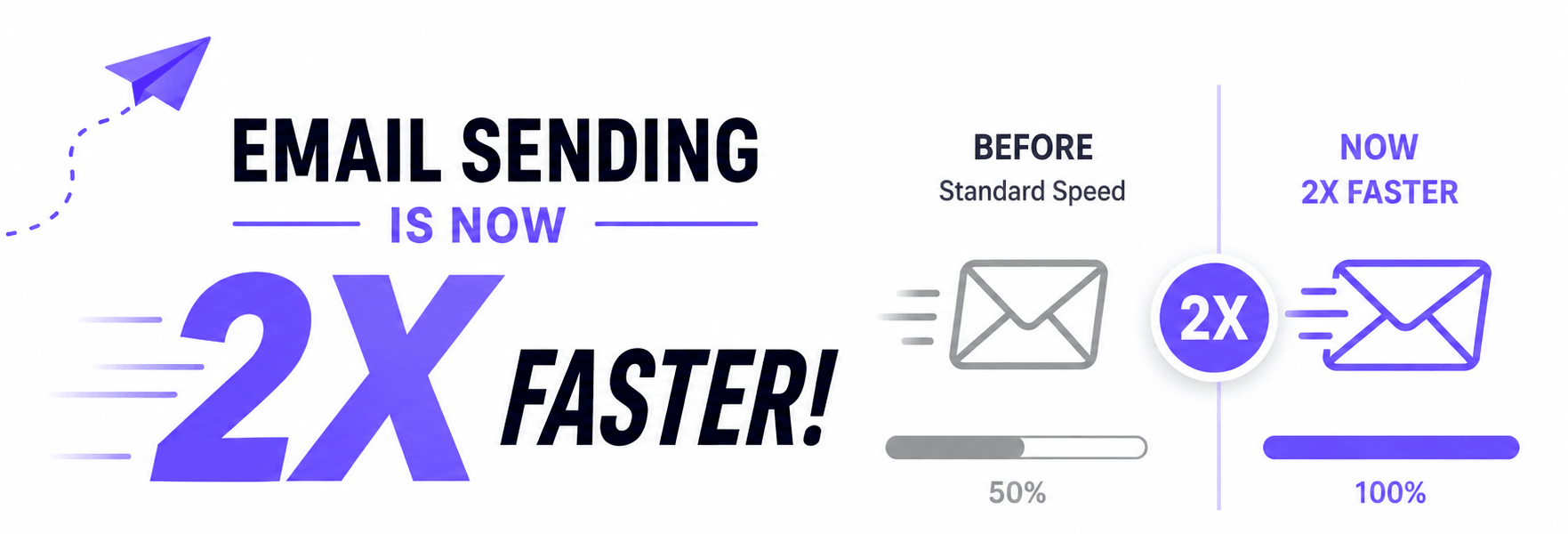
Whenever software companies advertise speed improvements, skepticism is healthy. But Sendy’s performance gains appear to be rooted in meaningful backend improvements rather than marketing exaggeration. Ben explained that the “2X faster” improvement is not about the Amazon SES sending limits.
Instead, the improvements come from making the entire internal sending pipeline dramatically more efficient.
In previous versions, bottlenecks existed around:
- queue handling
- campaign preparation
- database interactions
- sending workflows
- batch processing
v7 optimizes all of those layers!
That means if your SES account already has a large sending quota, Sendy can now feed campaigns into SES far more efficiently than before. For smaller lists, the difference may feel subtle, but overall will use less resources than before when sending. For large publishers, agencies, ecommerce brands, and high-volume senders, the gains become much more noticeable because small inefficiencies compound rapidly at scale.
The Biggest Improvements Are the Ones Most Users Will Never See
Ironically, some of the most important upgrades in v7 are almost invisible.
Ben highlighted major improvements around:
- database queries
- memory usage
- UI responsiveness
- sending workflows
- queue processing efficiency
- overall scalability
Most users will never directly notice an optimized database query. What they will notice is a platform that feels smoother, more responsive, and more reliable under load. That matters tremendously when you are managing hundreds of thousands of subscribers or sending large campaigns on tight schedules.
It also matters for agencies managing multiple brands from a single installation.
AI Features Without the AI Bloat
One of the newer additions to Sendy v7 is its AI Assistant functionality, via your own OpenAI API key.
That includes:
- AI-generated newsletter templates
- AI subject line generation
- content improvement assistance
- detailed AI-powered campaign report analysis
Importantly, these features feel additive rather than intrusive.
Some platforms today seem desperate to inject AI into every possible screen whether users asked for it or not.
Sendy’s approach appears more practical. The AI tools help accelerate workflows without turning the platform into an overcomplicated AI experiment.
Under the hood, we found that it uses the OpenAI "gpt-5.4-mini" model, and it works very well.
Why Self-Hosted Marketing Tools Are Becoming Relevant Again
The broader trend behind Sendy’s growth is actually larger than email marketing itself.
More businesses are starting to rethink platform dependence.
Creators are diversifying audiences.
Publishers are reclaiming infrastructure.
Businesses are trying to reduce recurring SaaS costs.
Agencies want more operational control.
Ben sees this shift clearly.
As he explained: “There’s also a growing need for businesses to own their audience and infrastructure instead of relying entirely on third-party platforms.”
That idea increasingly resonates in a world where platforms change rules constantly, pricing rises unpredictably, and businesses become dependent on ecosystems they do not control.
Self-hosted tools are no longer just for hobbyists and developers.
They are becoming strategic infrastructure.
Is Sendy for Everyone?
No.
And honestly, that is part of its appeal.
If someone wants a completely hands-off experience with zero technical setup, a traditional SaaS platform may still make more sense.
Sendy works best for:
- agencies
- developers
- publishers
- ecommerce brands
- technically comfortable businesses
- high-volume senders
- cost-conscious organizations
You do need hosting.
You do need Amazon SES.
You do need some technical comfort if doing it yourself (or partner with us).
But in exchange, you gain something increasingly rare in modern software: full control.
The Future of Sendy Looks Focused
One encouraging aspect of Ben’s vision for Sendy is that he does not seem interested in turning it into an over-engineered monster platform.
Ben told us, "I’m especially interested in making automation and integrations more powerful while still keeping Sendy lightweight and easy to use. There’s also a growing need for businesses to own their audience and infrastructure instead of relying entirely on third-party platforms, so I think self-hosted marketing tools are becoming increasingly relevant again. The goal is to continue improving Sendy in a way that gives users more control, performance, and flexibility without introducing unnecessary complexity."
That restraint matters.
A lot of beloved software products lose their identity by trying to become everything for everyone.
Sendy still feels purpose-built.
And now with Sendy v7, it feels significantly more mature.
Final Thoughts
There are plenty of email marketing platforms available today.
Many are polished.
Many are powerful.
Many are expensive forever.
Sendy continues to stand out because it offers something fundamentally different.
Ownership.
Control.
Low operating costs.
Scalability without subscriber penalties.
And with v7, the platform is no longer just the “cheap Mailchimp alternative.” It is evolving into a seriously capable email infrastructure platform for businesses that want long-term control over their audience and marketing stack. In an internet increasingly dominated by subscriptions, lock-in, and rising SaaS costs, that approach feels more relevant than ever.
We Can Help With Sendy
If you want the benefits of Sendy without the technical overhead, that is exactly where we come in. We provide fully managed, white-label Sendy setups where we handle everything from installation and SES configuration to template design, list management, and ongoing campaign execution.
For teams that want even more control, we can also host and maintain a dedicated Sendy instance tailored to your business, complete with expert support whenever you need it. Whether you are an agency scaling client campaigns or a business that just wants reliable, low-cost email infrastructure that actually performs, we make it simple to get started and keep everything running smoothly in the background.

We use and recommend Sendy only because we love it, and we also include our affiliate link in this post because that's their closest form of a partner program, or sign up with us as a managed brand, and we can use our license.
Let's Connect, We Can Help
|